"Sorry" has become a reflex for a lot of people — a way of taking up less space, keeping the peace, staying safe. Artho from Feelora on what compulsive apologising is really about and what it quietly costs you.
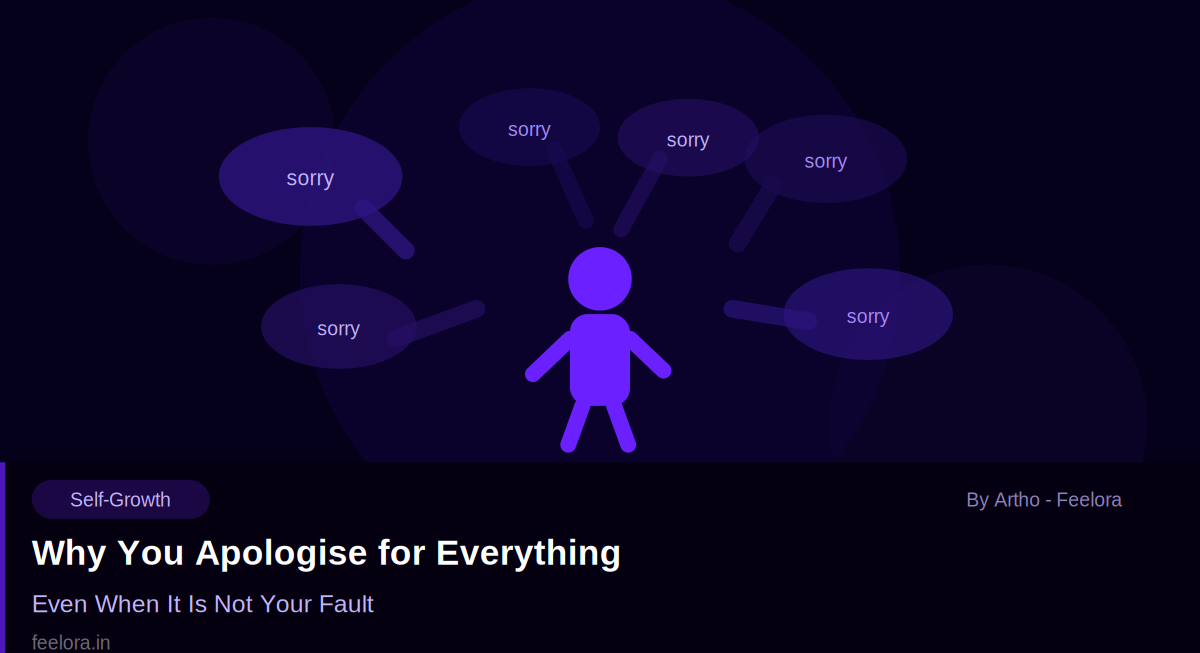
Notice it for one day and you might be surprised how often you say sorry. Sorry for speaking. Sorry for asking a question. Sorry for being in someone's way. Sorry for not responding immediately. Sorry for having an opinion. Sorry for needing something.
For many people, apologising has become so automatic it barely registers. But Artho from the Feelora team has spent time looking at what habitual, compulsive apologising is actually communicating — and what it quietly costs the people who do it.
What chronic apologising is actually about
Most habitual over-apologisers are not apologising because they have done something wrong. They are apologising because somewhere along the way, they learned that taking up space — asking for things, expressing needs, being inconvenient — came at a cost. The apology is pre-emptive. It softens the impact of your existence before anyone has a chance to object to it.
This pattern often develops in environments where conflict felt dangerous, where needs were regularly dismissed, or where someone important communicated — directly or indirectly — that you were too much. Sorry becomes a survival strategy: minimise yourself before someone else does it for you.
The real function of constant "sorry"
Apology in its genuine form is an expression of accountability — acknowledgment that you have caused harm and want to repair it. Reflexive apologising serves a different function: it is a tension-management tool. It pre-empts displeasure, smooths over discomfort, and signals "I am not a threat."
The problem is that it also signals something else: "I am not sure I deserve to be here." Over time, this seeps into how you are perceived by others — and, more significantly, how you perceive yourself.
What it costs you
Constant apologising erodes your authority. When you preface every statement with "sorry," you signal that your contribution is probably not worth listening to before it has even been heard. People in professional settings who over-apologise are often taken less seriously — not because their ideas are worse, but because they have communicated a lack of confidence in them before anyone else could form a judgment.
It also erodes your sense of legitimate entitlement to your own needs, space, and experience. The more you apologise for existing, the more your brain internalises the message that your existence requires apology.
How to start interrupting the pattern
The first step is noticing. Most over-apologisers do it so automatically they do not hear themselves. Start observing when "sorry" appears in your speech and what it is protecting against.
For many unnecessary sorries, there is a direct substitution that works and communicates more clearly: "Sorry for the late reply" becomes "Thank you for your patience." "Sorry to bother you" becomes "I have a question." "Sorry, I just think..." becomes "I think." The acknowledgment or the request remains. The unnecessary self-diminishment disappears.
This is a practice, not a switch. The urge to apologise will precede the awareness for a while. That is fine — the noticing matters most, at first. At Feelora, Artho and the team work with people unlearning exactly this. Your existence does not require apology. It just requires getting used to that fact.
Frequently Asked Questions
Feelora Team
Contributing Author
Need Someone to Talk To?
Connect with verified listeners on Feelora for anonymous, judgment-free emotional support.
Get Started