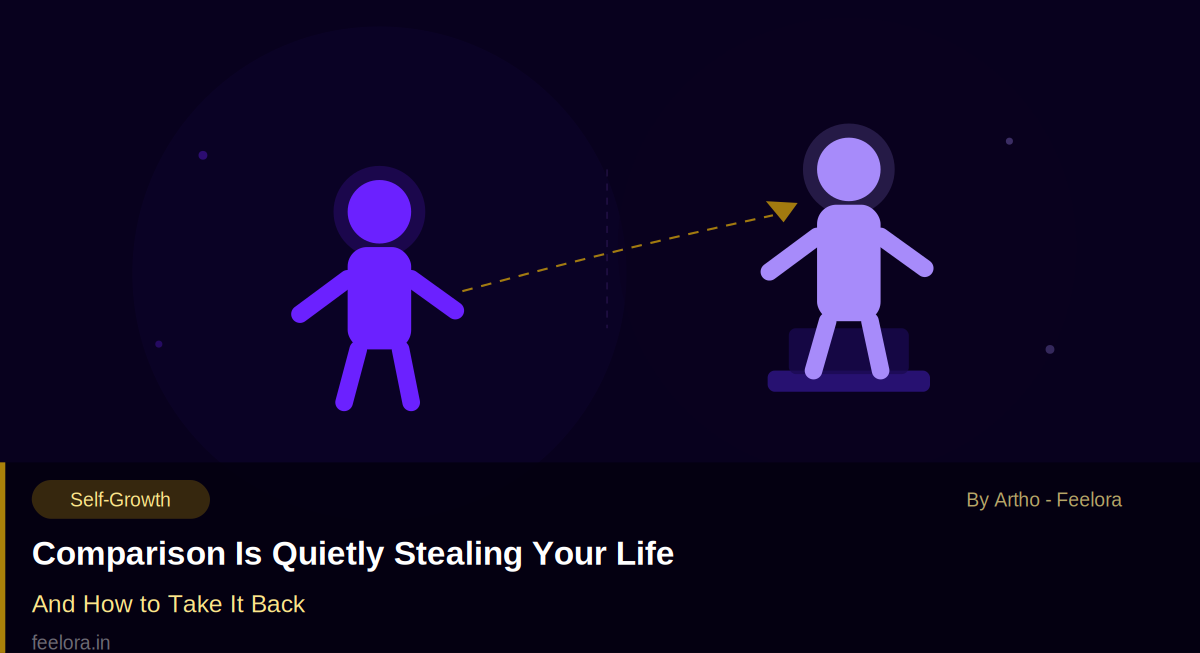
Someone else got the thing you wanted. Someone else seems to have figured out the thing you are still working on. Artho from Feelora on why comparison feels so compelling — and what it is actually taking from you.
Someone just announced something. A promotion. An engagement. A creative project that got picked up. And something contracted in your chest — something that is not quite jealousy and not quite sadness and has a note of something uncomfortably close to shame in it.
Comparison does not arrive loudly. It slips in through a screen, a conversation, a notification. And when it arrives, it does not just register what someone else has. It immediately tells you what that means about what you do not have. Artho from the Feelora team finds this to be one of the most consistently damaging habits people carry — and one of the most normalised.
Why comparison is so compelling
Social comparison is a fundamental feature of human cognition, not a character flaw. We are wired to gauge our standing relative to others — it was essential information for social animals living in groups. The problem is that this instinct evolved for small communities where comparison was based on direct experience of real lives. Applied to social media, where you are comparing your full experience of your own life to the curated highlights of hundreds of other lives simultaneously, the instinct produces wildly distorted results.
You are comparing your internal reality — all the doubt, the messy in-between, the days that are not going well — to other people's external performance. The comparison is structurally unfair before it even begins.
What comparison actually takes
The most significant cost is not envy. It is the way comparison redirects attention from your own life to a continuous assessment of how your life measures up. Every moment spent tracking where you are relative to someone else is a moment not spent building, creating, or simply experiencing what is actually in front of you.
Comparison also shifts goals from intrinsic to relative. Instead of asking "what do I actually want," the question becomes "what would put me ahead." These are very different questions, and the second one cannot be answered in a way that produces genuine satisfaction — because there will always be another point of comparison ahead of where you are.
The arrival fallacy
Comparison operates on an implicit promise: once you get what they have, you will feel the way you imagine they feel. But the thing you are comparing to is always a snapshot — an announcement, a photo, a visible milestone. You rarely see what the person actually feels about their own life, or what they are quietly comparing themselves to.
What to do instead
The antidote to comparison is not forcing gratitude. It is genuine engagement with your own life on its own terms — not as it measures up, but as it is. This usually starts with identifying what you actually value and want when the comparison framework is removed.
At Feelora, Artho and the team work with people who have spent so much time measuring themselves against others that they have lost track of what direction they were actually heading in. Recovering that direction is the work.
Frequently Asked Questions
Feelora Team
Contributing Author
Need Someone to Talk To?
Connect with verified listeners on Feelora for anonymous, judgment-free emotional support.
Get Started