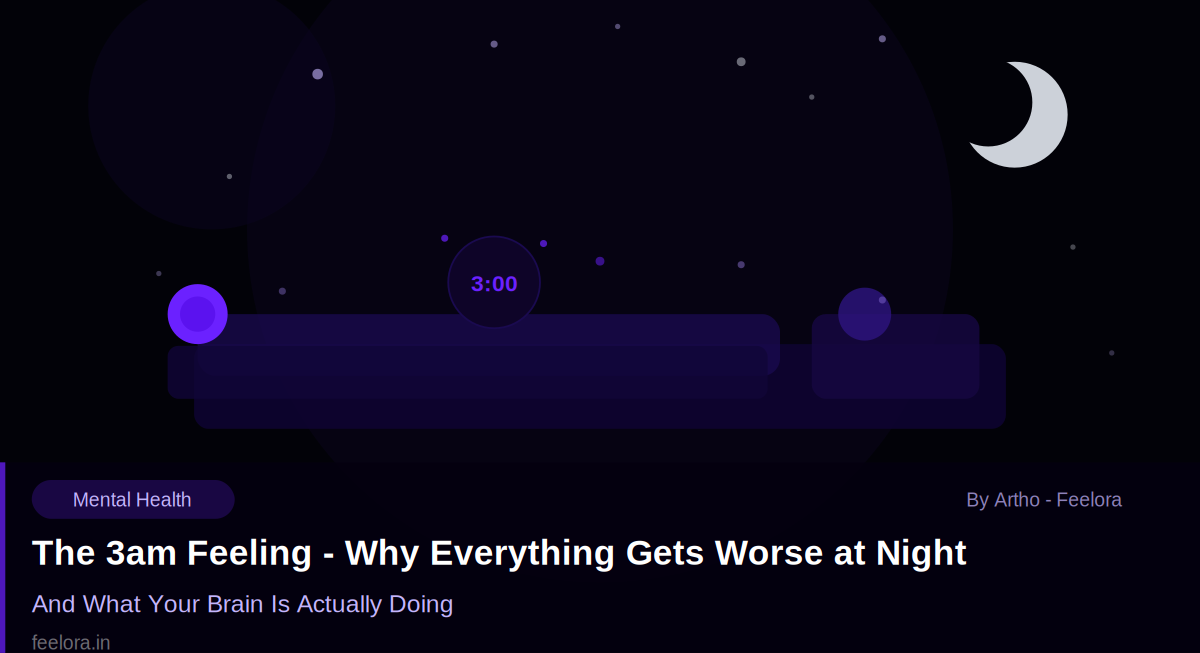
It is not in your head — your brain genuinely functions differently at 3am. Artho from Feelora explains the neuroscience behind why the dark hours feel unbearable, and what you can actually do about it.
3am has a particular quality to it that daylight never does. The thought that felt manageable at 11pm is now enormous. The anxiety that was background noise is now the only sound in the room. The problem that had a solution this morning now seems completely unsurvivable.
This is not weakness. This is not you being dramatic. Artho from the Feelora team has looked into what is actually happening neurologically at this hour — and your brain at 3am is genuinely different from your brain at 3pm.
Why the brain works differently at night
Several things converge in the middle of the night to make everything feel worse. Cortisol — the body's alert hormone — naturally rises toward morning, beginning its climb around 3 to 4am. This is the body preparing you to wake up. But when you're already awake and anxious, this cortisol spike amplifies threat perception. The brain becomes more vigilant, not less.
At the same time, the prefrontal cortex — your rational, context-providing, "this will be okay" brain region — is running at reduced capacity. The part that contextualises and reframes is partially offline. The part that registers threat is still fully operational. The result: the emotional brain is at full volume. The rational brain is barely a whisper.
The isolation effect
During the day, other inputs compete with your worried thoughts — work, other people, external demands. At 3am, all of that is gone. There is nothing between you and whatever is preoccupying you. The thought gets your full, undivided attention, and without anything to counterbalance it, it grows.
There is also a specific loneliness to middle-of-the-night wakefulness. Everyone else is asleep. The feeling that you are the only person lying awake in the dark amplifies whatever the thought already is. The isolation adds its own layer of distress on top of the original concern.
Why the same problem looks different by morning
In most cases, the problem has not changed. What has changed is your brain's capacity to relate to it. By morning, cortisol is stabilising, prefrontal function is restored, and other inputs are arriving to dilute the worry. The thought that felt catastrophic at 3am now feels like something with a solution — because your brain has access to more of its resources.
This does not mean 3am thoughts are meaningless. Sometimes they reveal genuine concerns the daytime mind has been avoiding. But the way they present — as unsolvable, shameful, irreversible — is a night-brain distortion, not an accurate assessment of reality.
What actually helps at 3am
Trying to solve the problem does not work at 3am. The brain does not have the capacity to problem-solve effectively at this hour, and attempting it usually extends the spiral. What helps instead is redirecting the nervous system: slow breathing, particularly extended exhales, grounding in physical sensations, and if thoughts are spinning, writing them down briefly. The act of writing removes the cognitive load of holding them.
It also helps to remind yourself explicitly: this is a 3am brain talking. Not a reliable narrator. The thought will look different by morning. This is not toxic positivity — it is physiologically accurate.
At Feelora, Artho and the team have built tools specifically for the difficult hours — because mental health support that only works in daylight is not doing its job. If 3am is hard for you, you are not alone, and it is not random. Your brain is doing something real. It just needs a little help getting through the night.
Frequently Asked Questions
Feelora Team
Contributing Author
Need Someone to Talk To?
Connect with verified listeners on Feelora for anonymous, judgment-free emotional support.
Get Started