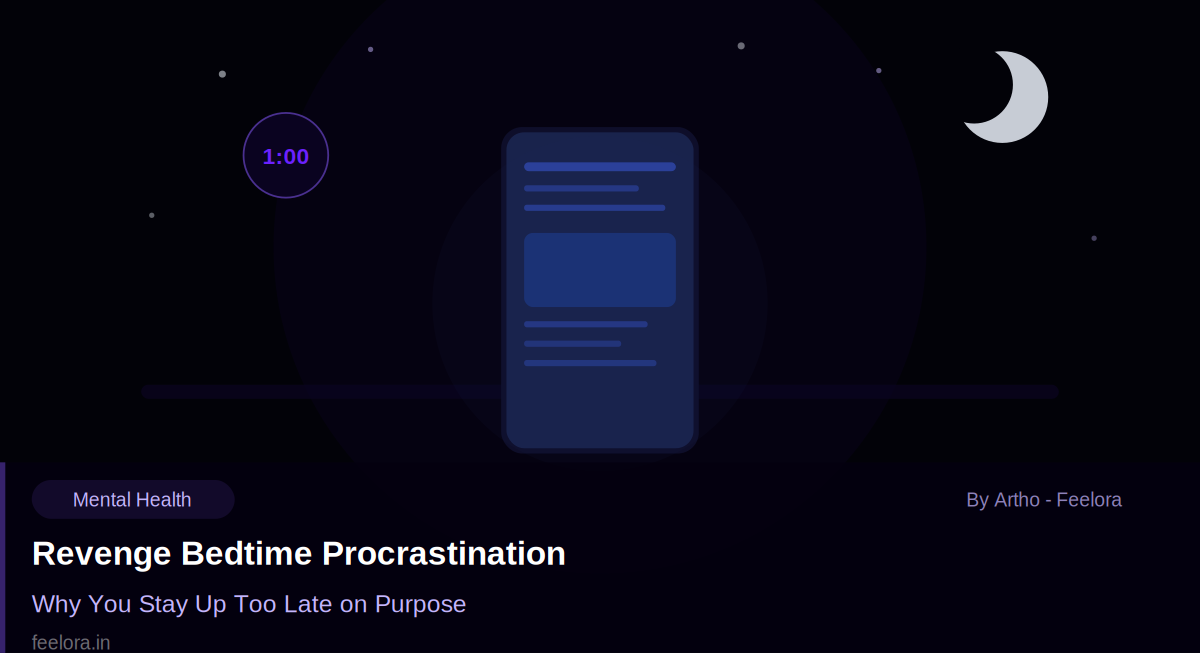
You are exhausted. You know you should sleep. You are still scrolling at 1am. It is not about discipline — it is about reclaiming the only time of day that belongs entirely to you. Artho from Feelora explains.
You are exhausted. You know you should sleep. You have an early start tomorrow. It is 1am and you are watching something you have already seen before, or scrolling through content you will not remember in the morning.
This is not a discipline problem. This is not a character flaw. There is a name for it: revenge bedtime procrastination. And Artho from the Feelora team found that once people understand what is actually driving it, it becomes a lot easier to address.
What it actually is
Revenge bedtime procrastination is the act of deliberately staying up later than you should in order to reclaim personal time at the end of a day that belonged largely to obligations — work, commute, family, responsibilities. The revenge is against the day itself. Late night is the only time that feels entirely yours.
The term comes from a Chinese concept that roughly translates to "revenge for staying up late," popular among workers who describe having no time during the day that belongs to them. But the experience is genuinely universal: if your day is full of things you have to do, the night becomes the space for things you want to do, even if what you want is simply to do nothing with your own mind.
Why it makes psychological sense
The need for autonomy — for time and space that you control — is a fundamental psychological need. When that need is not met during the day, the psyche looks for other windows. The problem is that it sacrifices sleep, which makes the next day harder to get through, which increases the sense of being depleted and needing recovery time, which makes revenge procrastination more likely the following night.
It is not about phone addiction
Blaming the phone misses the point. The phone is the vehicle; the need for unstructured personal time is the driver. Taking the phone away without addressing the underlying need would likely result in different late-night behaviour rather than earlier sleep. The question worth asking is not "why can I not put the phone down" but "what is my day missing that I am looking for at midnight."
What actually helps
The most effective intervention is not stricter sleep discipline. It is engineering the day to include enough time that feels genuinely yours — so the night does not have to carry the full weight of it. Even twenty to thirty minutes of genuinely unstructured, non-productive time during daylight hours can reduce the pull of late-night compensation.
At Feelora, Artho and the team work with people whose nights are their only breathing space. The solution is almost always about creating more breathing space in the day, not less in the night.
Frequently Asked Questions
Feelora Team
Contributing Author
Need Someone to Talk To?
Connect with verified listeners on Feelora for anonymous, judgment-free emotional support.
Get Started