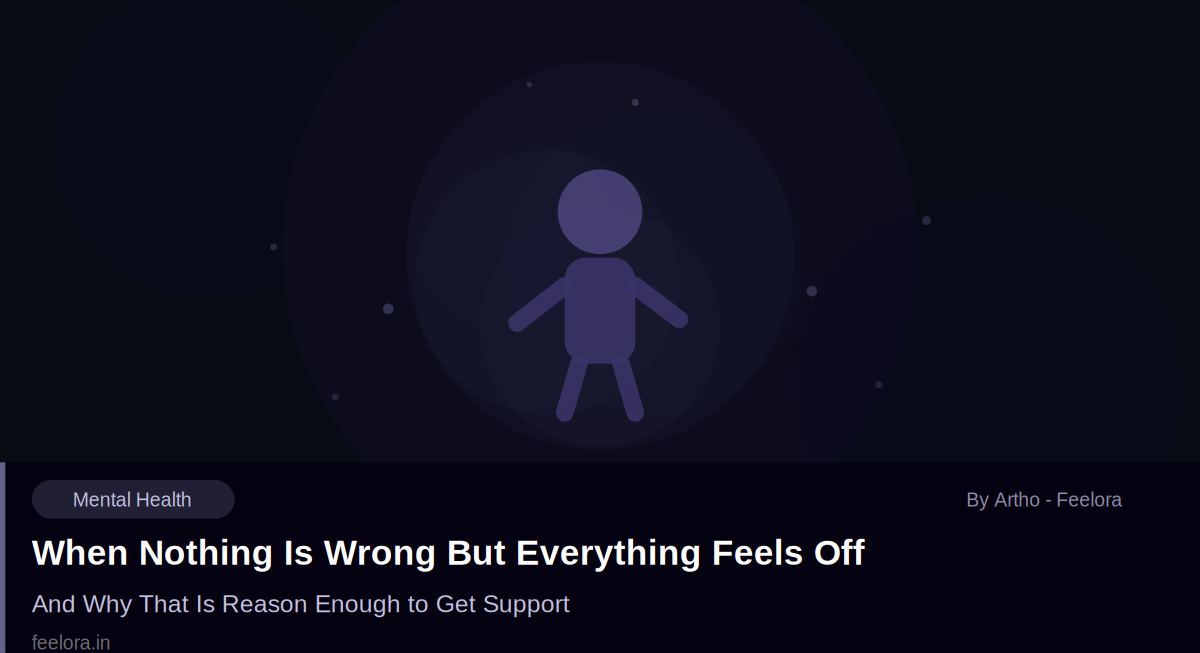
You have no reason to feel this way. Life is objectively fine. And yet there is this persistent grey feeling you cannot explain or justify. Artho from Feelora on what this actually is — and what helps.
You know what the matter is? Nothing, technically. Life is fine. Nothing catastrophic has happened. You have food and shelter and people who care about you. By any objective standard, things are okay. And still — there is this persistent, low-level greyness. A flatness. A vague sense that something is off that you cannot locate, justify, or explain.
Artho from the Feelora team gets asked about this feeling more than almost any other. Because unlike anxiety, which has an object — unlike sadness, which usually has a cause — this one is frustratingly free-floating. Which means it is also the hardest to talk about. How do you explain that you are struggling when nothing is wrong?
What this feeling might actually be
Several things can produce this kind of grey, undirected flatness. One of the most common is low-grade cumulative stress that has not been named or processed — the background hum of demands, decisions, and responsibilities that do not individually feel overwhelming but collectively drain something essential. The tank is empty, but the depletion happened so gradually there was no moment that felt like a crisis.
Another is emotional suppression. When feelings are consistently set aside — "I will deal with this later," "it is not that serious," "other people have it worse" — they do not disappear. They go quiet. The result is often this kind of affective flatness, where nothing feels very good or very bad. The emotional system has partially shut down to protect itself.
A third possibility is what psychologists call languishing — not depression, not burnout, but the absence of flourishing. You are functioning and not falling apart, while also not thriving. Life feels like going through motions without quite connecting to why the motions matter.
Why "I have no reason to feel this way" makes it worse
The moment you qualify your experience with "but my life is fine," you add shame to the discomfort. The implication is that feelings require justification — that struggling without a reason is self-indulgent. This framing both invalidates the experience and blocks the path to addressing it, because it is hard to seek support for something you have already decided does not merit it.
Feelings do not require justification to be real. The grey feeling is data. It is information about something your system needs. It does not need a dramatic enough cause to count.
What tends to help
Getting specific is usually the first step. Rather than sitting with "something feels off," ask: off from what? What does a day that does not feel like this look like? What is present in those days that is absent now? The greyness is often a symptom; specificity helps locate the cause.
Reconnecting with things that used to generate genuine feeling also helps — not forcing enjoyment, but deliberately scheduling activities that have historically worked, and paying attention to what shows up. Even small signals of aliveness are worth noting.
And talking about it helps, even when nothing is wrong. Externalising the feeling with someone who will not immediately ask what caused it — who can sit with you in the ambiguity — tends to reduce its intensity even without resolving its source.
At Feelora, Artho and the team work with people who feel too fine to justify getting support and too not-fine to keep going without it. That space is real. You do not need a reason big enough to qualify. The grey feeling is reason enough.
Frequently Asked Questions
Feelora Team
Contributing Author
Need Someone to Talk To?
Connect with verified listeners on Feelora for anonymous, judgment-free emotional support.
Get Started