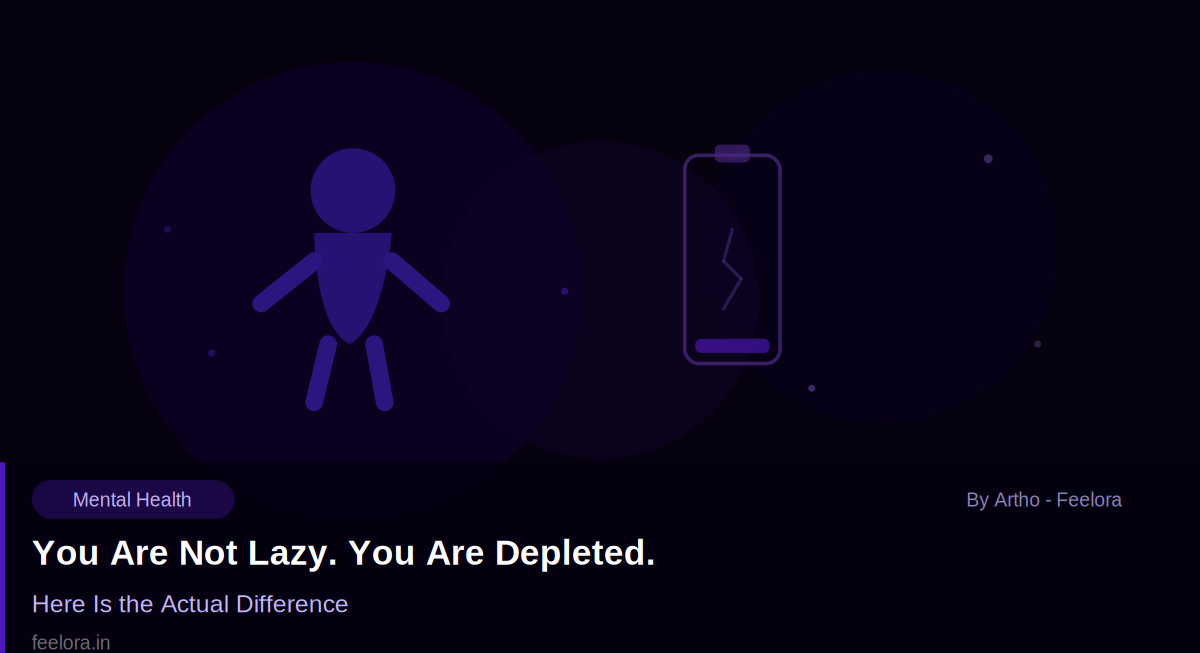
Lazy is when you could and won't. Depleted is when you want to and can't. Most people confusing the two are being unfair to themselves in ways that make recovery harder. Artho from Feelora breaks it down.
There is a word a lot of people use about themselves that is doing significant damage: lazy. "I am just being lazy." "I know I should do it but I am lazy." "I do not know what is wrong with me, I am so lazy."
Artho from the Feelora team hears this often — and almost always, when you get underneath it, what people are actually describing is not laziness at all. It is depletion. And these two things require completely opposite responses.
The actual difference
Laziness — genuine, straightforward disinclination — is when you could do something and choose not to. It involves having the resources available and deciding not to use them. It is relatively rare as a fixed trait, and in most people it is actually task avoidance rooted in anxiety or perfectionism rather than true indifference.
Depletion is different. It is when you want to do something — genuinely want to — and find that the capacity is not there. You sit down to start and nothing happens. You tell yourself to begin and the instruction does not land. You have been running on low reserves for so long that the system has started shutting down non-essential activity to preserve what is left.
Lazy is choosing not to. Depleted is not being able to. The difference matters enormously, because the solution to one makes the other worse.
How the "just push through it" response fails
If you believe you are lazy, the response is to push harder. Do more. Force yourself to function. This works on genuine motivation problems. Applied to depletion, it drains what little resource remains and creates shame on top of exhaustion. People in real depletion often feel deeply ashamed of their inability to function at their previous capacity — and that shame is itself depleting.
The appropriate response to depletion is not pressure. It is replenishment. Which, frustratingly, looks a lot like resting — the very thing guilt and self-criticism are working hard to prevent.
Signs you are depleted rather than lazy
You care deeply about the thing you cannot do. Lazy people are not usually distressed about not doing the thing. Depleted people are. The gap between how much you care and how little you can produce is one of the most reliable indicators.
You function better in some areas than others. Depletion is usually domain-specific or time-limited. The work task feels impossible, but you can still have a conversation or make food.
You have been under sustained strain without adequate recovery. Depletion does not appear suddenly. It accumulates over weeks or months of output consistently exceeding input.
What replenishment actually looks like
Real recovery from depletion is not passive. Lying on the couch scrolling provides distraction but not restoration. Genuine replenishment involves activities that return energy rather than just pause the drain: physical movement, genuine social connection, creative activity, time in nature — whatever the individual finds actually restorative, not what sounds productive or virtuous.
At Feelora, Artho and the team work with people who have spent months calling themselves lazy for something that was a reasonable response to unreasonable conditions. Being kind to yourself about this is not giving up. It is a prerequisite for getting back to full capacity.
Frequently Asked Questions
Feelora Team
Contributing Author
Need Someone to Talk To?
Connect with verified listeners on Feelora for anonymous, judgment-free emotional support.
Get Started