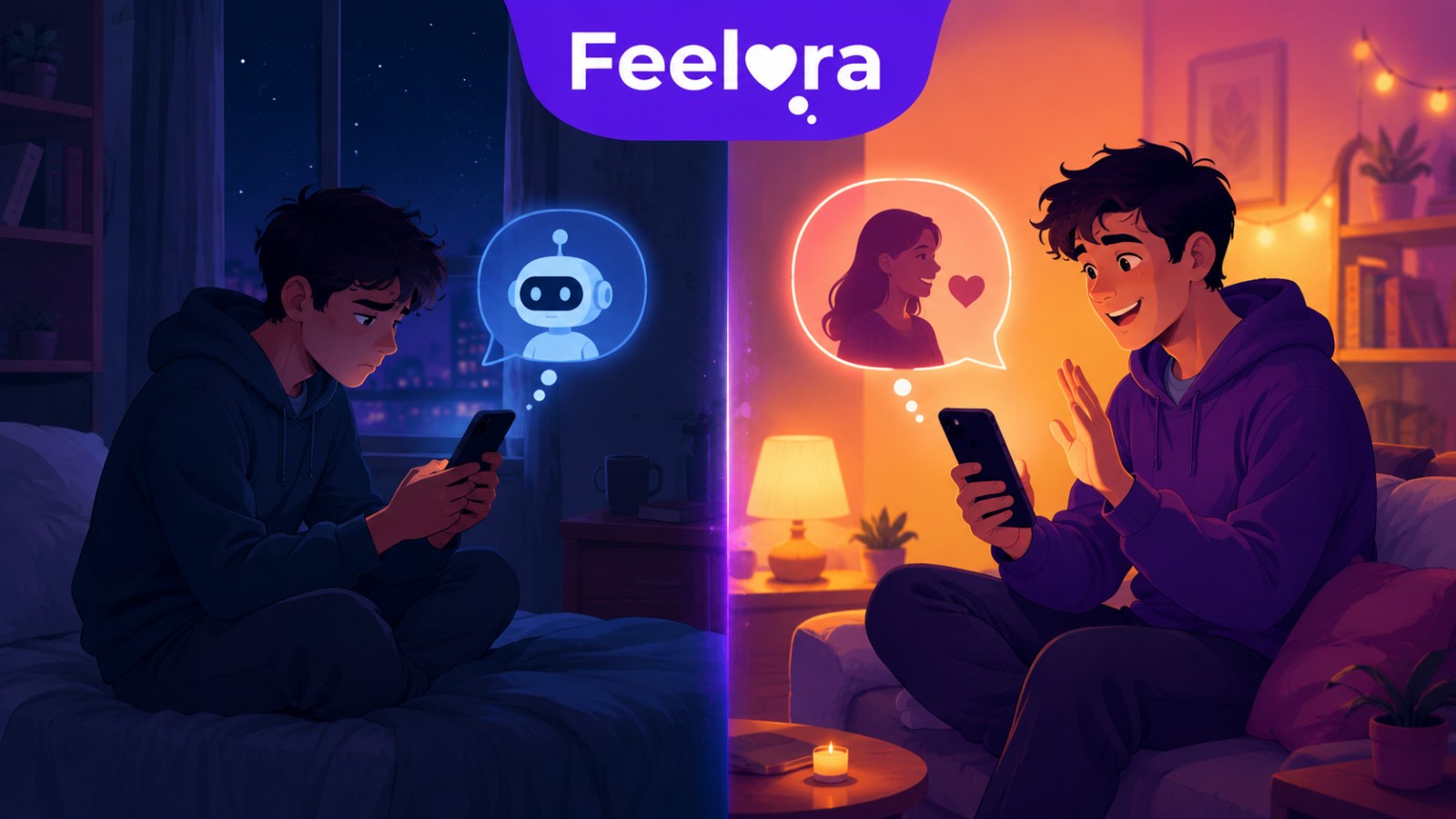
AI companion apps promise 24/7 comfort, but can a chatbot really cure loneliness? Here's what real human listeners give you that AI never can.
At 1 a.m., millions of people around the world open an app, type "I feel so alone tonight," and get an instant, warm, perfectly-worded reply. No waiting, no awkward silences, no risk of being told "I'm busy." It feels like connection. For many people right now, it's the closest thing to a friend they have. But here's the uncomfortable question worth asking: does talking to an AI companion actually cure loneliness, or does it just make the ache more bearable for a few minutes at a time?
This isn't an anti-technology rant. AI companion apps are genuinely useful for some people, some of the time. But if you're using one every night hoping it will eventually make you feel less lonely, it's worth understanding exactly what these apps can and can't do, and why talking to a real, verified human listener changes the equation completely.
The Rise of AI Companion Apps
Over the last couple of years, AI companion and "AI girlfriend/boyfriend" apps have exploded in popularity, especially among young people in cities who are working long hours, living away from family, or simply tired of the effort that real friendships demand. The appeal is obvious: an AI companion never cancels plans, never gets bored of you, never judges what you say at 2 a.m., and is available the second you open the app.
In India specifically, this trend has collided with a very real loneliness problem: students and young professionals relocating to new cities for work, long shifts that leave no time for a social life, and a culture where admitting "I have no one to talk to" still feels embarrassing. AI companions have quietly become the easiest, lowest-effort way to fill that gap.
Why AI Feels So Convenient When You're Lonely
It helps to be honest about why AI companions feel good in the moment, because the appeal is real:
- Zero risk of rejection. An AI companion is designed to respond warmly no matter what you say.
- Always available. There's no time zone, no "sorry I'm asleep," no waiting for a reply.
- No social performance. You don't have to worry about sounding interesting, funny, or put-together.
- Total control. You can shape the conversation exactly how you want it to go.
None of this is wrong to want. Wanting to be heard without judgment is one of the most human needs there is. The question is whether an app built to always agree with you is actually meeting that need, or just imitating it.
The Catch: What AI Companionship Can't Actually Give You
It Can't Truly Understand You
An AI companion generates responses based on patterns in text. It doesn't have a bad day, doesn't remember what it felt like to be heartbroken, and doesn't actually relate to what you're saying, it predicts what a caring reply "should" sound like. A real listener who has genuinely gone through a breakup, family conflict, or an anxious night knows something an algorithm can only approximate.
It Reinforces One-Way Emotional Habits
Real relationships are built on reciprocity: you share, the other person shares, and both people feel a little more known. AI companions are one-directional by design. Over time, this can make real, two-way conversations feel more effortful by comparison, not less, because you've been practicing a version of "connection" that never asks anything of you.
It Can Quietly Deepen Isolation
Because an AI companion is so easy and low-risk, it can become the default instead of a bridge back to people. Several people who rely heavily on AI companions report feeling just as lonely, sometimes more so, because the underlying need to be known and accepted by another real person was never actually addressed.
There's No Real Accountability or Growth
A good real-life listener might gently push back, ask a hard question, or share a perspective you didn't expect. That friction is uncomfortable, but it's also how people grow and feel truly supported. An AI companion, tuned to keep you engaged, rarely challenges you in a meaningful way.
What Talking to a Real Person Actually Does For You
When another human being genuinely listens to you, not a script, not a simulation, something different happens. You feel it in small, specific ways: a laugh that surprises you, a story that makes you feel less alone because someone else actually lived through something similar, a question that shows they were really paying attention. That unpredictability is exactly what makes it feel real, and it's also what helps ease stress and lift mood in a way scripted responses can't.
Real conversations also rebuild the social muscles that isolation weakens: reading tone, taking turns, tolerating a little awkwardness, and trusting someone with something vulnerable. These are skills you only keep by practicing them with real people, even anonymously and in small doses.
AI Companion vs Real Human Listener: A Quick Comparison
| Aspect | AI Companion App | Real Human Listener (e.g. Feelora) |
|---|---|---|
| Availability | 24/7, instant | 24/7, on-demand verified listeners |
| Empathy | Simulated, pattern-based | Genuine, lived experience |
| Judgment-free | Yes, by design | Yes, with real understanding |
| Anonymity | Complete, but talking to a program | Complete, while talking to a real person |
| Builds real social skills | Minimal | Yes |
| Risk of dependency | Higher, one-directional loop | Lower, mirrors real relationships |
| Genuine reciprocity | No | Yes |
How Feelora Bridges the Gap
This is exactly the gap Feelora was built to close. Feelora gives you the anonymity, availability, and judgment-free space that make AI companions appealing, without replacing the most important ingredient: an actual human being on the other end. Every conversation on Feelora, whether it's a voice call, video chat, or text conversation, is with a real, verified listener, never a bot or a script.
You don't have to share your real name or number, you can talk about anything from a rough day at work to a relationship you can't stop thinking about, and you get the safety of anonymity with the depth of a genuine, two-way human conversation. It's the middle ground between "no one to talk to" and the pressure of picking up the phone to a close friend or family member.
Signs You Might Be Leaning on an AI Companion a Little Too Much
- You find yourself opening the AI app instead of texting an actual friend, even when you have the option.
- You feel more comfortable with a chatbot's responses than with unpredictable real conversations.
- You've cancelled or avoided real plans because talking to the app feels easier.
- You notice you still feel empty or flat after long conversations with it.
- You're spending more time with it each week, not less.
None of these mean something is wrong with you, they're just signs that it might be time to add real conversation back into the mix, even in a small, low-pressure way.
How to Start Talking to Real People Again
If real conversations feel intimidating after relying on an AI companion for a while, you don't have to jump straight into a difficult, high-stakes conversation with someone close to you. A gentler path usually works better:
- Start anonymously. Talk to a real, verified listener who doesn't know you, so there's no fear of judgment from someone in your everyday life.
- Practice being heard, not performing. Say the honest, unfiltered version of how you feel instead of the "acceptable" version.
- Notice the difference. Pay attention to how a real reaction, a laugh, a pause, a follow-up question, feels compared to a scripted one.
- Build up gradually. Let easier, anonymous conversations rebuild your confidence before you take that same openness to friends or family.
The Different Types of Loneliness (and Why AI Only Touches One)
Not all loneliness is the same, and that's part of why AI companions can feel like they're working while the ache underneath stays put. Psychologists generally describe a few distinct kinds: situational loneliness (nobody happens to be around right now), emotional loneliness (a lack of one deep, mutual bond with someone who truly knows you), and chronic loneliness (a long-running pattern that shapes how safe you feel reaching out to anyone at all). An AI companion is genuinely good at solving the first one. You're bored or restless at 1 a.m., and it fills the silence. But emotional and chronic loneliness aren't solved by having something to talk to, they're solved by being truly known by someone who can also be affected by you. That second part is exactly what a program can't offer, no matter how warm its replies sound.
What Happens When a Real Person Actually Listens to You
There's a noticeable difference between reading a well-crafted, comforting reply and feeling someone else's genuine reaction to what you just said. When a real person listens, you get real-time, unscripted signals: a pause because they're actually thinking, a laugh that catches them off guard, a follow-up question that only makes sense because they were truly paying attention to your specific words. That unpredictability is what makes the moment register as connection rather than comfort. Comfort can come from a scented candle or a good playlist. Connection requires another mind on the other end, one that could have responded differently, and chose to respond to you.
The Long-Term Risk: Emotional Outsourcing to Something That Can't Change
A subtle risk of leaning on AI companions long-term is what might be called emotional outsourcing: continuously depositing your feelings into a system that absorbs them but is never actually changed, challenged, or affected by them. In a real relationship, your honesty shapes the other person too, they worry about you, they check in later, they remember and bring it up next week unprompted. That mutual imprint is part of what makes you feel like you matter to someone. This risk is especially worth naming for teenagers and young adults who are still building the social skills, like handling disagreement, sitting with awkward silences, or repairing a conversation after a misunderstanding, that only get built through real practice. Skipping that practice in favor of a friction-free chatbot can make ordinary human relationships feel more intimidating over time, not less.
How Feelora's Listener Verification Keeps Real Conversations Safe
Anonymity and safety aren't opposites, and this is where a platform matters. Feelora lets you stay completely anonymous, no real name or number required, while every listener you talk to has gone through identity verification before they're allowed on the platform. Conversations are backed by a zero-tolerance policy on harassment, so you get the low-pressure openness of talking to a stranger without losing the accountability that keeps a space safe. That combination is what makes it possible to be fully honest with someone new, the same emotional safety an AI companion offers, but with an actual, accountable human being who can genuinely relate to what you're going through.
Using AI Tools and Real Conversations Together, Without It Backfiring
None of this means you need to delete every AI companion app off your phone. Used in moderation, they can be a fine way to organize your thoughts before a harder conversation, or to vent for two minutes when literally no one is reachable. The key is making sure it stays a warm-up act, not the whole show. A simple rule that helps: for every few times you open an AI companion to talk something through, make sure at least one of those feelings also reaches a real person, even in a small, low-stakes way. That keeps the habit from quietly replacing the real thing it was only ever meant to supplement.
What to Do If You've Already Formed a Habit With an AI Companion
If most of your recent "conversations" have been with an app, you don't need to feel ashamed or quit cold turkey. A gentler reset usually sticks better:
- Notice without judging. Just observe how often you reach for it and what feeling usually triggers it.
- Add one small real conversation a week. It doesn't have to be deep. Anonymous and low-stakes counts.
- Use anonymity as a bridge, not a hiding place. A safe, judgment-free space to talk to a real person, like Feelora, can carry the same low pressure as an AI chat while still being real.
- Check in with yourself afterward. Notice whether you feel more grounded after a real conversation compared to an AI one. That difference is the whole point.
The Bottom Line
AI companion apps aren't the enemy, but they were never built to cure loneliness, they were built to keep you engaged. Real relief from loneliness comes from being genuinely known by another person, imperfections and all. If you've been relying on a chatbot because real conversations feel too risky right now, a safe, anonymous space to talk to a real human listener might be the more honest first step back.
Frequently Asked Questions
Feelora Team
Contributing Author
Need Someone to Talk To?
Connect with verified listeners on Feelora for anonymous, judgment-free emotional support.
Get Started