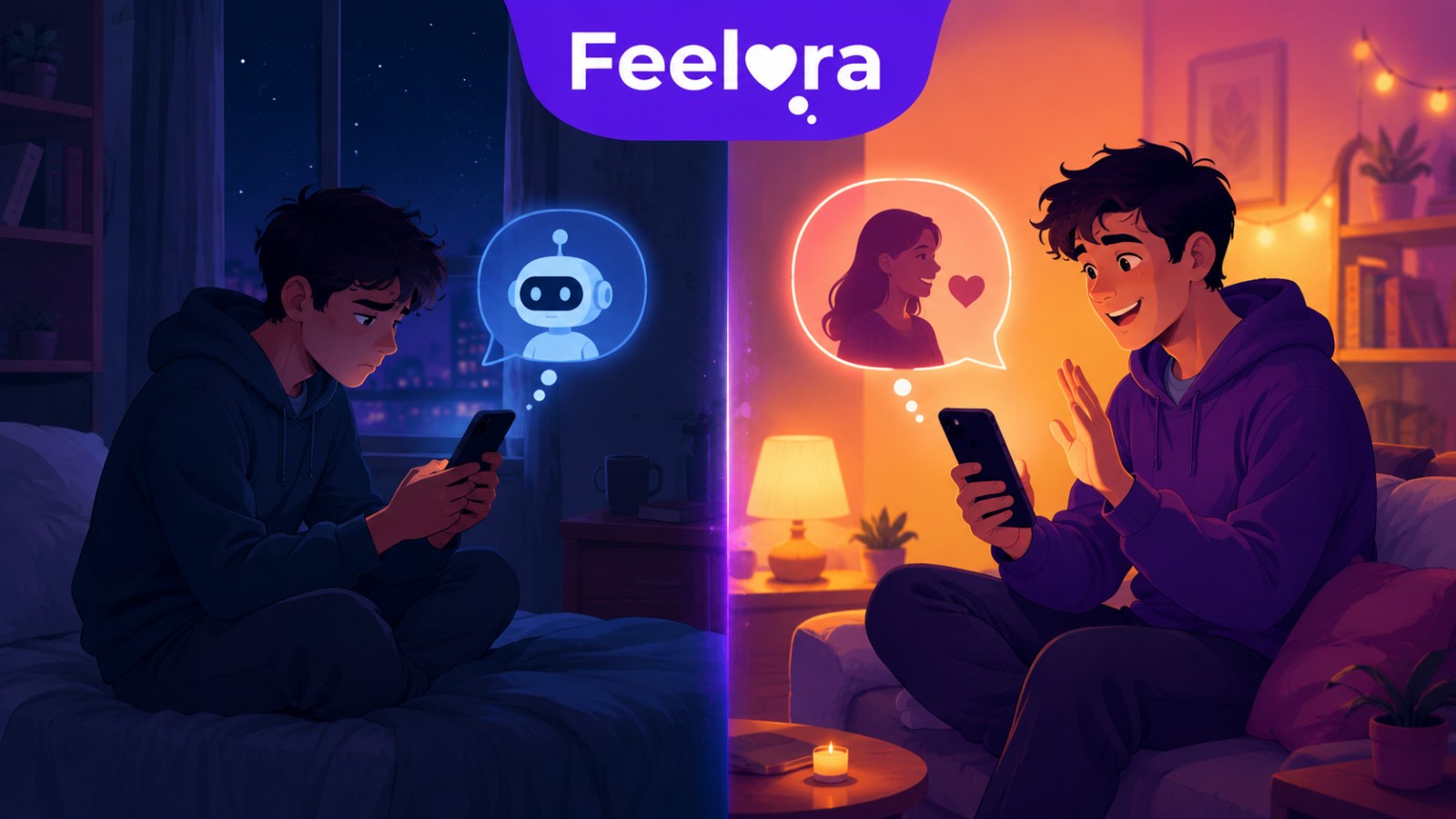
Overthinking at 2am with no one to call? Talk to a real, verified listener on Feelora — anonymous, judgment-free, anytime.
You know the exact feeling. The lights are off, the day is technically over, and your brain decides this is the moment to replay a conversation from three weeks ago, frame by frame. Did that message sound weird? What did they actually mean by that? Why did I phrase it that way? None of this happens by choice. It's just what an unprocessed day sounds like once everything else has gone quiet.
Why Overthinking Gets Worse at Night, Specifically
During the day, there's enough noise — meetings, notifications, traffic, other people — to keep racing thoughts from fully taking over. At night, that noise disappears, and whatever wasn't processed during the day gets the floor to itself. This isn't a character flaw or a discipline problem. It's simply what happens when a full day of unprocessed thoughts finally gets a quiet room to run around in.
The Real Problem With 2 AM Isn't the Thoughts — It's Being Alone With Them
Most overthinking would actually resolve faster with a second voice in the room. Saying a thought out loud to another person — even a stranger — forces it into a shape that's easier to examine than the version looping silently in your head. The trouble is, at 2 am, the people who'd normally listen are asleep, and reaching out feels disproportionate to what's actually happening. "I can't call my friend to talk about a work email" is a very reasonable thought — and it's also exactly the gap that leaves people lying awake instead of talking it through.
What Actually Helps in the Moment
Say it out loud, even to yourself, before trying to think your way out of it. Thoughts that stay entirely internal tend to loop. The same thought, spoken or typed out to another person, usually starts to lose its grip within a few minutes — this is sometimes called affect labeling, and it's one of the more reliable, well-documented reasons "just talking about it" actually works.
Lower the bar for what's worth talking about. You don't need a crisis to justify a conversation. A replayed conversation from work, a message you're not sure how to interpret, a decision you're circling — all of it is a completely normal thing to talk through, even at an hour when it feels like an overreaction to bring up.
Have somewhere to go that isn't dependent on someone else being awake. This is the specific gap Feelora is built around — a verified listener, available at 2 am as easily as 2 pm, so the hour itself stops being the obstacle to talking something through.
How Feelora Works for Late-Night Conversations
You open the app, get matched with a verified listener, and start talking — by chat if typing feels easier at that hour, or by call if you want an actual voice in the room. There's no need to explain why you're up, or apologise for the time. Listeners on Feelora are available across different hours specifically because overthinking doesn't run on a 9-to-5 schedule, and neither should the option to talk it through.
A Short Toolkit for the Next Time This Happens
The two-minute brain dump. Before reaching for your phone to scroll, spend two minutes writing down every thought in the loop, unfiltered, without trying to solve anything. This doesn't resolve the thoughts, but it gets them out of pure repetition mode and into something you can actually look at.
The "will this matter in a week" filter. Not to dismiss the feeling, but to sort it. Most 2 am replays fail this test — the awkward phrasing in a message, the slightly off tone in a meeting — and naming that out loud often does more to quiet it than trying to reason your way past it.
One sentence, said to one person. You don't need a long conversation to interrupt a loop. Sometimes a single sentence — "I keep replaying something dumb I said today" — said to a listener is enough to take the thought out of your head and into a shape you can actually examine.
Separate the thought from the hour. The version of a problem your brain generates at 2 am is reliably harsher and more urgent-feeling than the same problem at 10 am. Reminding yourself of this pattern, even mid-spiral, can create just enough distance to loosen its grip.
A Few Things Worth Knowing About 2 AM Thinking
The version of a problem your brain produces at 2 am is rarely the most accurate one. Fatigue, low light, and the absence of any outside input all make thoughts feel bigger and more urgent than they usually are in daylight. This is part of why saying something out loud — even just once, to one other person — has an effect disproportionate to how small the sentence sounds. It interrupts the loop instead of feeding it.
It's also worth separating ordinary late-night overthinking from something heavier. Replaying a slightly awkward conversation is common and manageable. Persistent, distressing thoughts that don't ease with talking, or thoughts of self-harm, are a different category that needs a different response — a licensed professional, or in an emergency, India's number, 112, not a listening app.
Why the Body Makes This Worse, Not Just the Mind
There's a physical layer to this too. Lying still in the dark tends to increase interoceptive awareness — your attention to internal sensations like heart rate and breathing — which can make an anxious thought feel more physically urgent than it would sitting upright in daylight, mid-conversation, with somewhere to direct your attention. This is part of why simply sitting up, turning on a light, or talking to someone can shift the entire feel of a 2 am spiral, even before the actual content of the thought has changed at all.
Building a Better Relationship With Nighttime Thoughts
Over time, people who talk things through regularly — rather than only when a thought becomes unbearable — tend to find that the nightly spiral loses some of its intensity. It's not that the thoughts stop showing up. It's that they stop feeling like the only option is to lie there and wait them out alone. Knowing there's somewhere to take a 2 am thought, even occasionally, changes the relationship with the thought itself.
Frequently Asked Questions
Team Feelora
Contributing Author
Need Someone to Talk To?
Connect with verified listeners on Feelora for anonymous, judgment-free emotional support.
Get Started