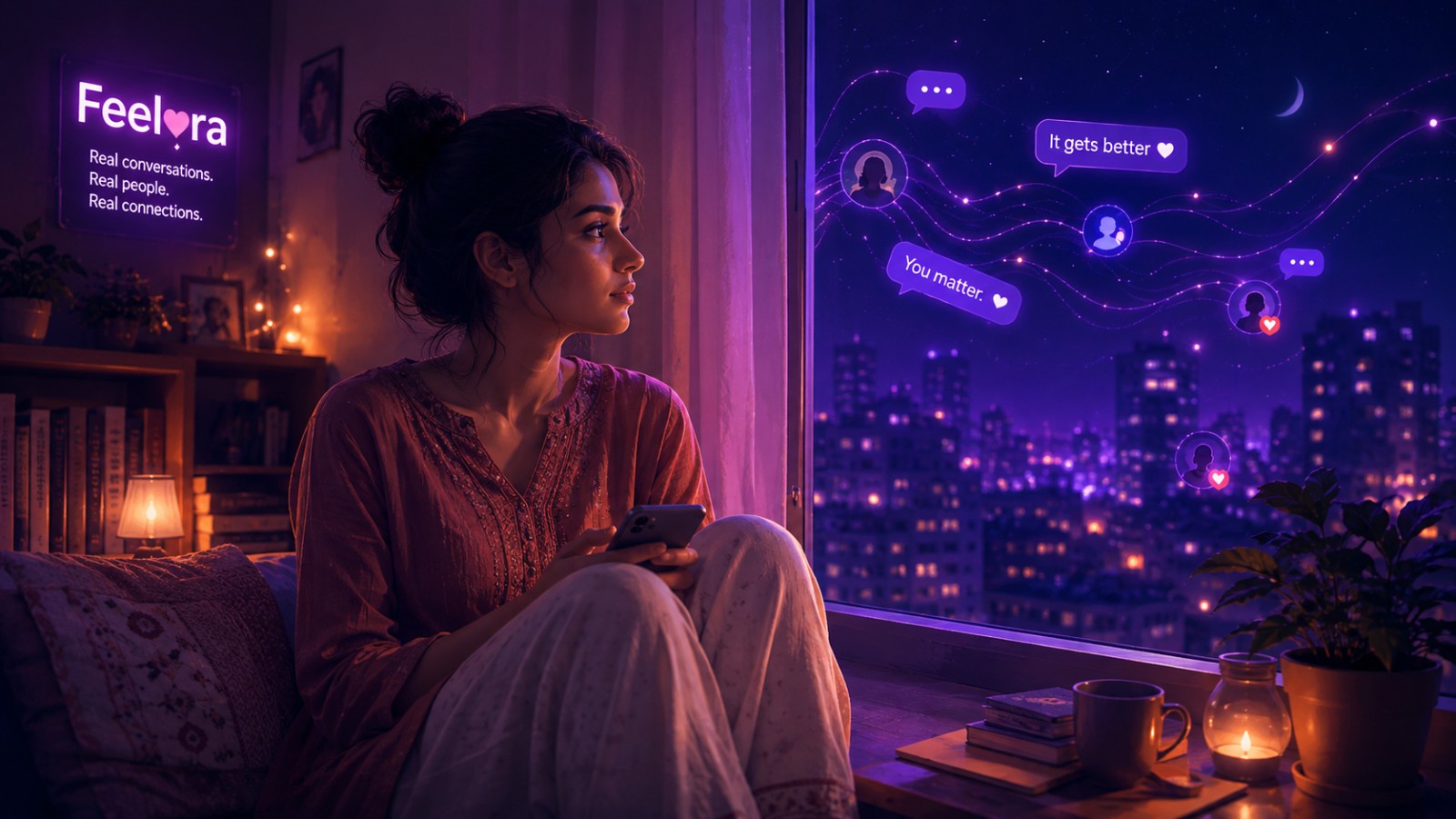
Indian families rarely talk feelings openly. Here's why, and where to go when you need to — Feelora, judgment-free, anonymous.
"Sab theek hai." Everything's fine. It's one of the most common answers in Indian households to "how are you doing," and it's often said even when nothing is fine at all. This isn't dishonesty — it's a pattern most people picked up long before they had the words to describe it: the sense that feelings, especially difficult ones, aren't really meant to be said out loud at home.
Where This Pattern Actually Comes From
A lot of it traces back to "log kya kahenge" — what will people say — a phrase that shapes far more than just big life decisions. It quietly teaches that emotional struggles are something to manage privately, not something to bring to the dinner table. Add to that a generational gap where many parents were raised with even less language for emotions than their children have now, and the result is a house where everyone can talk about marks, careers, and marriage prospects fluently, but stumbles the moment the topic turns to how someone's actually feeling.
None of this makes Indian families uniquely closed off — most cultures have some version of this pattern. But the specific shape it takes here — respect expressed through not burdening elders, love expressed through provision rather than conversation — means a lot of people grow up fluent in everything except naming their own emotional state out loud.
How This Plays Out Differently Across Generations
The pattern isn't identical across every household. Parents who grew up in the 60s, 70s, and 80s were often raised in larger joint families where privacy itself was limited, and emotional restraint was as much a practical survival skill as a cultural value — with many people in one house, keeping difficult feelings contained kept the household functioning. Their children, now adults themselves, often grew up with more exposure to therapy, mental health conversations in media, and the language to name what they're feeling — but frequently still default to the older pattern at home, because that's the model they were raised inside, even if they consciously want something different.
This is why a lot of people describe feeling emotionally fluent with friends their own age, but reverting to "sab theek hai" the moment they're actually talking to a parent — it's not a contradiction, it's two different sets of learned rules operating in two different contexts.
The Cost of "Sab Theek Hai" as a Default Answer
Saying "I'm fine" enough times doesn't just hide a feeling from other people — over time, it can make it genuinely harder to identify what you're feeling in the first place. The habit of deflecting becomes automatic, faster than the more honest answer even has time to form. This is part of why so many people, when finally asked directly by someone with no stake in the answer, are surprised by how much comes out — not because the feelings are new, but because they've rarely had a real chance to be said.
Why This Shows Up Even in "Modern," Close Families
It's not only distant or strict families where this happens. Plenty of people describe genuinely warm, close relationships with their parents that still hit a wall the moment the topic turns emotional — not from lack of love, but from lack of practice. Parents who grew up in households with the same "sab theek hai" pattern often don't have a model for how to receive a difficult feeling without immediately trying to fix it, minimise it, or worry visibly enough that their child regrets bringing it up at all.
What This Means Day to Day
It shows up in small, specific moments: not mentioning the anxiety before a big exam because it might worry your parents. Not telling your family about a breakup until it's long over and safely resolved. Describing a stressful work situation only in the most neutral, factual terms, stripped of how it actually felt. Over time, this creates a strange split — a person can be extremely close to their family in every practical sense, and still never have said an honest sentence about their inner life to any of them.
Where the Feeling Actually Needs to Go
Feelings that don't have anywhere to go don't disappear — they tend to surface anyway, just less directly: as irritability, as exhaustion that doesn't match the day's actual events, as a low hum of restlessness. This is exactly why having somewhere to talk that exists outside the family system matters, not as a replacement for those relationships, but as a release valve that doesn't carry the same weight of "will this worry them" or "log kya kahenge."
A verified, anonymous listener solves this specific problem cleanly. There's no relationship to protect, no family reputation attached, and no risk of the conversation changing how anyone at home sees you. You can say the honest version of "how are you doing" — the one that doesn't start with "sab theek hai" — without managing anyone else's reaction to it.
If You Do Want to Try Talking to Family — A Gradual Approach
For people who do want to slowly build more openness at home, starting with the biggest, most difficult feeling first is usually the hardest way to do it. A gradual approach tends to work better: sharing something small and low-stakes first — a mildly stressful day, rather than a major struggle — to see how it's received, before working up to bigger conversations. Noticing how a parent responds to the small version gives useful information about how ready they are to hear the bigger one, without risking the bigger disclosure on a first attempt. This isn't about permanently avoiding harder conversations at home — it's about sequencing them in a way that's more likely to actually go well.
How Feelora Fits Into This
Feelora is built around exactly this kind of conversation — private, judgment-free, with no connection to your family, your community, or your reputation. You choose what to talk about, share as much or as little as you want, and talk to a verified listener whose only role is to actually hear the answer, not manage it. For a lot of users, it becomes the one place where "sab theek hai" isn't the automatic response, simply because there's finally no reason for it to be.
This Doesn't Mean Giving Up on Talking to Your Family
None of this is an argument for staying closed off with people you love — plenty of families do slowly build more emotional openness over time, especially as conversations around mental health become more normal in India generally. But that's a gradual shift, and it doesn't have to happen before you're allowed to talk to someone honestly. Having an outside space to say things clearly first often makes it easier, later, to find the words for the people closer to home.
Say the honest version, not "sab theek hai." Download Feelora and talk to a verified listener today.
Frequently Asked Questions
Team Feelora
Contributing Author
Need Someone to Talk To?
Connect with verified listeners on Feelora for anonymous, judgment-free emotional support.
Get Started