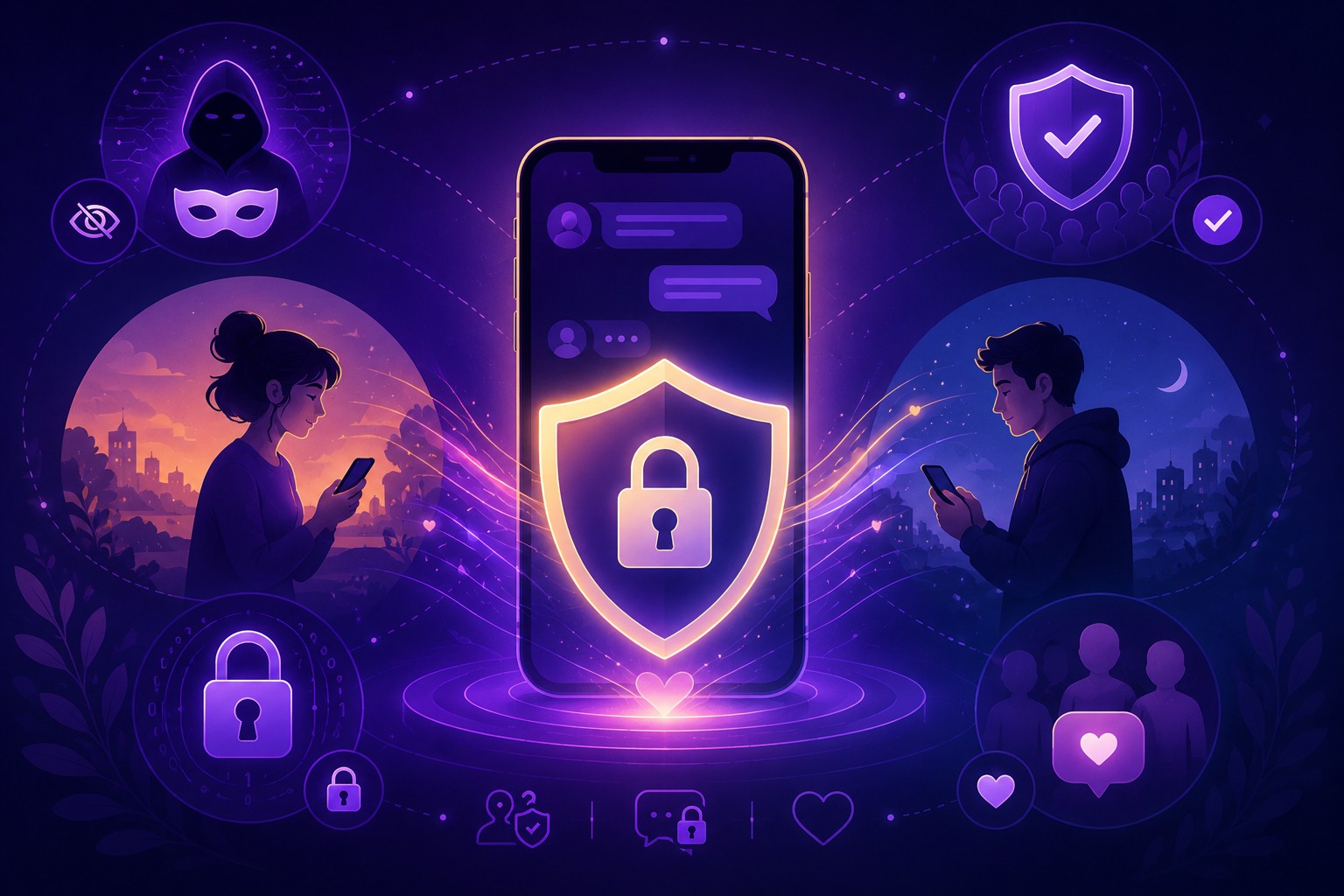
Complete guide on anonymous chat safety. Learn what makes anonymous apps safe, how to protect yourself, and which platforms are actually secure.
The honest answer: It depends.
Anonymous chat can be incredibly safe, or it can be extremely risky. The difference comes down to choosing the right platform and knowing how to protect yourself.
In this guide, we'll explain exactly what makes anonymous chat safe or unsafe, how platforms protect users, and how to keep yourself secure while using anonymous apps.
The Quick Answer
Safe anonymous chat requires:
- Verified users (identity checks)
- Moderation (community guidelines enforcement)
- Encryption (data protection)
- Accountability (consequences for bad behavior)
- Your smart choices (what you share)
Unsafe anonymous chat has:
- No verification
- No moderation
- No encryption
- No consequences
- Zero safety features
Choose the first type. Avoid the second.
What "Anonymous" Actually Means
Important: anonymous doesn't mean lawless.
The Real Definition
Anonymous chat is a platform where other users don't know your real name, your real identity is protected, you choose what to share, but the platform itself knows who you are for safety purposes.
What It Doesn't Mean
- The platform doesn't know who you are
- You have zero accountability
- You can do anything without consequences
- Your data isn't protected
- Everyone on the platform is vetted
The best anonymous platforms combine anonymity for users (your identity hidden from others) with verification by the platform (so it can act when needed).
How Anonymous Platforms Protect You
Layer 1: Identity Verification
The process typically works like this: you submit an official ID, the platform confirms you're real, your ID is never shared with other users, and the platform can identify you if you violate the rules.
This helps because one person equals one account, the platform can remove bad actors, there's accountability if someone violates terms, and you know you're talking to a real person. Meanwhile, your real name stays hidden from other users, other users can't see your ID, and you still remain anonymous to them.
Layer 2: Encryption & Data Protection
Encryption scrambles your messages so only you and the recipient can read them, the platform can't read your private messages, and hackers can't intercept conversations.
End-to-end encryption means only you and the other person can read messages — the platform can't, making it the most secure option. Platform encryption means messages are encrypted while traveling but the platform can read them for moderation purposes — still decent security. No encryption means anyone can intercept messages, so avoid apps without this.
Look for phrases like "end-to-end encrypted" messages, "SSL/TLS secured" connections, a privacy policy stating encryption practices, and transparency about data practices.
Layer 3: Moderation & Community Guidelines
Moderation typically works in five steps: clear rules are set as community guidelines, a reporting system lets users flag violations, the platform investigates reports, violators face consequences, and persistent bad actors get removed.
What gets moderated usually includes harassment and abuse, hate speech, sexual content, scams and money requests, threats, and doxxing or sharing personal info.
Layer 4: Zero-Tolerance Policies
The strongest platforms enforce zero-tolerance: one violation leads to consequences, there are no second chances for serious violations, bad actors are removed swiftly, and accountability is clear. For example, one harassment complaint triggers an investigation, one scam attempt results in a permanent ban, and one threat leads to immediate removal.
This matters because bad actors know they won't get away with it, victims report violations knowing action will be taken, the community stays safe, and repeat offenders are prevented.
Common Risks (And How Safe Platforms Prevent Them)
Risk #1: Talking to Fake People or Bots
The problem: you think you're talking to a real person, but it's a bot or fake account. Safe platforms prevent this through verification, trained listeners with a known background, reporting to remove fakes, and community ratings that flag suspicious accounts. Protect yourself by choosing verified platforms only, reporting suspicious behavior, trusting your gut, and blocking liberally.
Risk #2: Someone Asking for Money
Watch for red flags like urgent requests for cash, claims of losing a job, requests for travel fare, or promises to pay double. Safe platforms block money discussions, remove requesters, educate users, and report fraud to authorities. Never send money to online friends — block immediately and remember that real friends don't ask for money.
Risk #3: Someone Asking for Personal Information
People may ask for your real name, location, or social media to build trust before catfishing, doxxing, or scamming you. Safe platforms remind users not to overshare, remove those who pressure others, and ban persistent requesters. Never share identifying details until you're comfortable, and block anyone who pushes — real friends respect your pace.
Risk #4: Sexual Content or Harassment
Safe platforms enforce strict moderation, content filters, one-strike policies, and permanent bans. If this happens to you, block immediately, report to the platform, don't engage, and remember your comfort matters.
Risk #5: Being Doxxed (Identity Revealed)
Doxxing happens through oversharing, pieced-together information, malicious searching, or weak platform privacy. Safe platforms enforce anonymity, ban the sharing of real names, remove doxxers immediately, and protect your privacy. Avoid sharing identifying info, location, or work and school details — stay vague about your personal life.
Risk #6: Your Data Being Sold or Hacked
Safe platforms invest in strong data security, transparent privacy policies, regular security audits, encryption across systems, GDPR compliance, and a strict no-data-selling policy. Protect yourself by reading the privacy policy, checking security certifications, using strong passwords, enabling two-factor authentication, and reporting breaches immediately.
How to Identify Safe Anonymous Platforms
Green Flags (Safe Platform)
- Identity verification required
- Clear community guidelines
- Easy reporting system
- Zero-tolerance policy stated
- Encryption mentioned
- Transparent privacy policy
- Visible moderation team
- Users can give feedback
- Blocks and bans for violations
- Regular security updates
Red Flags (Unsafe Platform)
- No registration needed
- No community guidelines
- Can't report abuse
- No consequences for violations
- No mention of encryption
- Vague privacy policy
- No visible moderation
- No user feedback option
- Bad reviews about safety
- Obvious fake accounts
If a platform shows three or more red flags, avoid it.
Your Personal Safety Checklist
What Not to Share (Ever)
- Real full name
- Your exact location
- Home address
- Work address
- School name
- Social media usernames
- Phone number
- Email address
- Financial information
- Intimate photos
- Detailed family info
What's Safe to Share
- Interests and hobbies
- General thoughts and feelings
- Vague location (e.g. "I'm in India")
- Relationship status
- Career field, not company
- Jokes and humor
- Life goals and dreams
- What you're struggling with
- What you're working on
- Your personality traits
Red Flag Behaviors in Conversations
Immediate Block If They:
- Ask for money
- Ask for intimate photos
- Pressure you to share personal info
- Get angry when you set boundaries
- Claim they're desperately lonely
- Talk about meeting in person within days
- Ask you to keep secrets
- Try to isolate you from friends
- Share intimate info immediately (love-bombing)
- Don't respect when you say no
Your safety matters more than their feelings. Block.
Safety in Practice: The Feelora Example
Verification: official ID required, background checks conducted, ongoing monitoring in place.
Anonymity: your real name stays hidden, other users only see your chosen identity, and you control all personal info.
Encryption: messages are encrypted, calls are secured, and data is protected.
Moderation: an active moderation team, 24/7 reporting availability, and fast responses to reports.
Zero-Tolerance: one harassment complaint triggers an investigation, one scam attempt results in a ban, one threat results in removal, and there are no second chances for serious violations.
Accountability: every listener is verified, every violation is tracked, and community safety is prioritized.
The Legal Aspect
Anonymous doesn't mean illegal. You can chat anonymously, use a pseudonym, and protect your identity. You cannot harass others, threaten others, commit fraud or scams, share illegal content, dox others, or break platform rules. Platforms report illegal activity to authorities, so don't assume anonymity means no consequences.
Comparison: Safe vs Unsafe Anonymous Chat
Safe Anonymous Chat Platform
- Verified users
- Your anonymity protected
- Active moderation
- Consequences for violations
- Encryption
- Clear privacy policy
- Users feel safe
Unsafe Anonymous Chat Platform
- No verification
- Anonymity encourages bad behavior
- No moderation
- No consequences
- No encryption
- Privacy concerns
- Users report harassment
The Psychological Aspect
The Disinhibition Effect
When anonymous, people sometimes say things they wouldn't offline, break social norms, or behave badly if consequences don't exist. Safe platforms counter this by maintaining consequences, enforcing community guidelines, and removing bad actors quickly. Unsafe platforms enable it by removing consequences, letting anonymity hide bad behavior, and having zero moderation.
What to Do If Something Goes Wrong
Someone Harassing You
- Block them immediately
- Take screenshots of messages
- Report to the platform
- Request their removal
- Trust that the platform will act
Someone Asked for Money
- Block immediately
- Report for fraud
- Never send money
- Delete messages
- Don't feel guilty
Someone Shared Your Info
- Report immediately for doxxing
- Block all connections
- Request a platform investigation
- Document everything
- Alert people close to you
Platform Not Acting
- Contact support
- Escalate the complaint
- Consider leaving the platform
- Report to authorities if illegal
- Leave a review warning others
The Bottom Line
Anonymous chat can be completely safe if you choose the right platform (verified and moderated), make smart choices (don't share personal info), know the red flags (and block liberally), trust the platform (zero-tolerance policies), and protect your privacy (best practices).
Anonymous chat is dangerous if the platform has no verification, you overshare personal info, you ignore red flags, the platform has no consequences, or you break your own safety rules.
Your safety is in your hands. Choose wisely.
Ready for Safer Anonymous Chat?
Looking for a safe, verified anonymous chat platform? Download Feelora — identity verified listeners, encrypted chats, a zero-tolerance policy, and your privacy protected.
Learn more about verified listeners and how they're different or see our app comparison to others.
Frequently Asked Questions
Feelora Team
Contributing Author
Need Someone to Talk To?
Connect with verified listeners on Feelora for anonymous, judgment-free emotional support.
Get Started