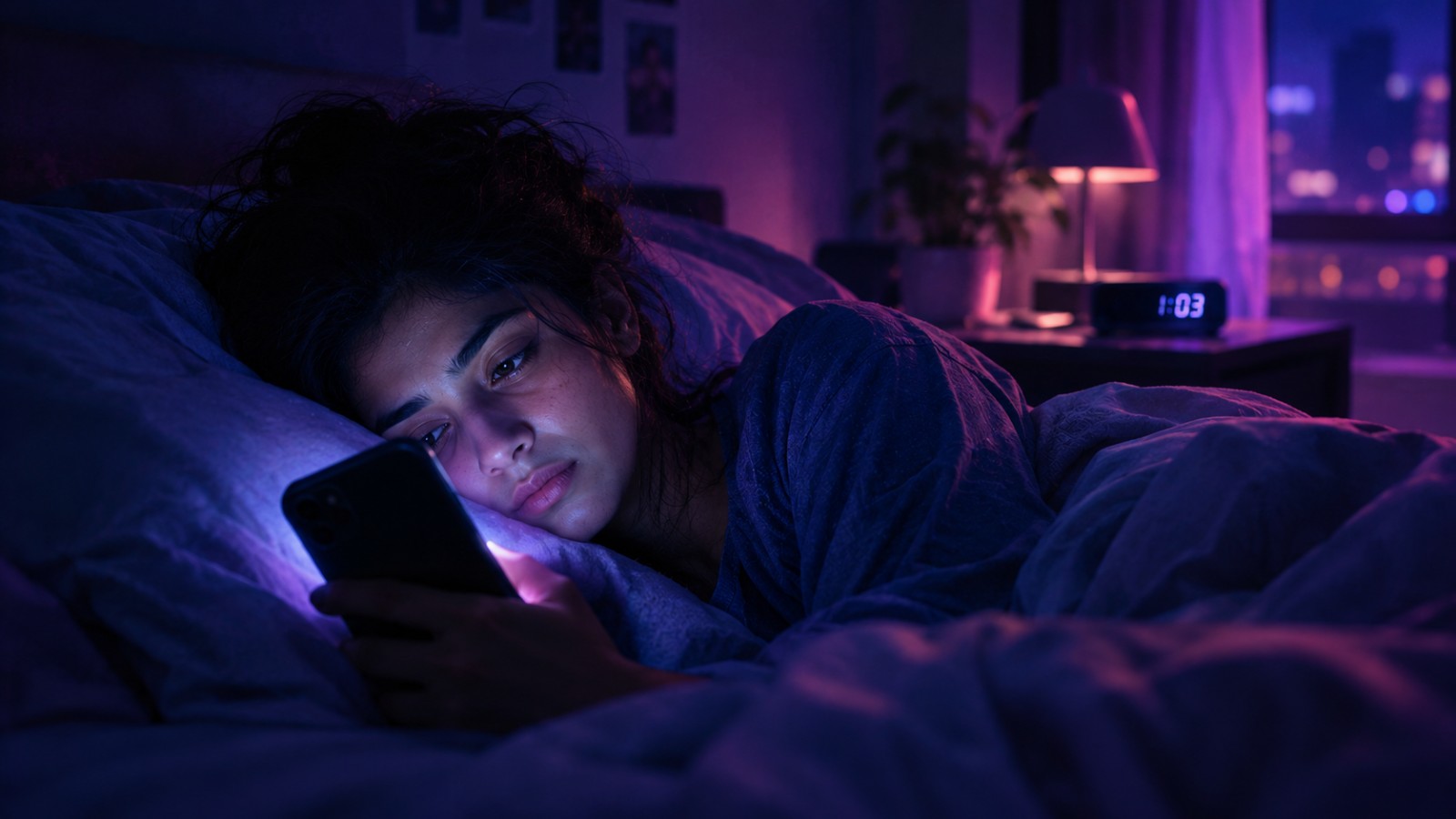
It's 1 AM, you're exhausted, and you're still scrolling. Here's what's actually happening in your brain during a late-night doomscroll, why willpower alone won't fix it, and the specific changes that do.
It's past midnight. You told yourself you'd be asleep an hour ago. Instead you're three scrolls deep into a feed that's somehow cycling between a stranger's breakup, a war update, a recipe you'll never make, and a video essay about something you didn't know you cared about. Your eyes are heavy, your thumb is not. You know you should put the phone down. You don't.
This specific, late-night version of scrolling has a name now: doomscrolling. And while it feels like a personal discipline failure, it's actually a fairly predictable collision of brain chemistry, app design, and the particular vulnerabilities that show up at 1 AM specifically. Understanding why it happens is what actually makes it possible to stop, far more than another round of "just put your phone in another room" advice.
What Doomscrolling Actually Is
Doomscrolling refers to the compulsive consumption of negative, alarming, or emotionally loaded content, usually through endless-scroll feeds, well past the point of it being useful or informative. The term picked up traction because it captures something subtler than ordinary procrastination: the content itself is often upsetting, yet the scrolling continues anyway. That combination, feeling worse with every scroll but being unable to stop, is the defining feature.
Late at night, this pattern intensifies. The same behavior at 1 PM might be a five-minute distraction. At 1 AM, it can swallow an hour or more, and it tends to leave people more anxious, more wired, and significantly less rested than when they started.
Why Your Brain Does This at 1 AM Specifically
Doomscrolling isn't random, and it isn't evenly distributed across the day. Several things converge specifically at night that make it far more likely.
Decision fatigue has already set in. By late evening, the part of your brain responsible for self-control, the prefrontal cortex, has been working all day and is measurably less effective. Resisting a dopamine-triggering feed takes real cognitive effort, and that's exactly the resource you have the least of at 1 AM.
Your brain is primed to treat novelty as reward. Every swipe carries the small possibility of something interesting, funny, or alarming. That unpredictability triggers dopamine release in a pattern similar to a slot machine. Variable rewards are famously more compelling than consistent ones, which is precisely why infinite-scroll feeds are built this way in the first place.
Nighttime lowers emotional regulation. Tiredness doesn't just make you sleepy, it also reduces your ability to regulate emotional reactions. Content that you'd shrug off at noon can hit much harder at midnight, which paradoxically makes it more gripping, not less.
The quiet itself is uncomfortable. For a lot of people, nighttime is the only part of the day without external noise, obligations, or distraction. That silence often leaves room for anxious or unresolved thoughts to surface, and scrolling becomes a way to drown them out rather than sit with them.
Blue light and stimulation delay sleep signals. Screen light suppresses melatonin production, and emotionally charged content keeps your nervous system in a mildly activated state. The result is a body that feels tired but a mind that's too stimulated to actually fall asleep, so the scrolling continues almost as a holding pattern.
Why It Feels Compulsive, Not Just Habitual
A habit is something you do on autopilot. A compulsion is something you do despite not wanting to, and doomscrolling frequently crosses that line. This happens because the behavior is reinforced on multiple levels at once.
On a neurological level, the anticipation of new content, not even the content itself, is what drives the dopamine spike. That's why people often report scrolling past things they don't even care about. The reward isn't the content. It's the act of checking.
On an emotional level, doomscrolling can function as a strange form of self-soothing. Negative content, especially about large-scale events, can create a false sense of control, as though staying informed is a form of safety. In reality, most late-night scrolling doesn't inform, it just accumulates distress without offering any way to act on it.
On a behavioral level, the environment is engineered for this exact outcome. Infinite scroll removes natural stopping points. Autoplay removes the small pause where a decision could happen. Notification badges and algorithmic sorting keep surfacing exactly the content most likely to trigger another swipe. None of this is accidental, and understanding that can help remove some of the self-blame that usually comes with this habit.
The Real Cost of a 1 AM Scroll Session
- Delayed sleep onset, often by 30 to 90 minutes beyond what you intended
- Lower sleep quality even once you do fall asleep, due to lingering cortisol and mental stimulation
- Next-day anxiety that feels diffuse and hard to pin to one cause
- A skewed sense of how dangerous or chaotic the world is, since negative content is disproportionately surfaced and shared
- A cycle where poor sleep increases next-day stress, which increases the urge to doomscroll the following night
That last point is worth sitting with. Doomscrolling and poor sleep aren't two separate problems, they tend to feed each other in a loop that gets harder to break the longer it runs.
How to Actually Stop (Not Just "Delete the App")
Generic advice like "have more willpower" fails because it ignores the mechanics above. What actually works addresses the triggers directly.
1. Create a genuine physical barrier
Keep the phone outside arm's reach, ideally outside the bedroom entirely, with a separate alarm clock if you use your phone as one. The goal isn't willpower, it's removing the decision altogether. You can't compulsively check something you'd have to get out of bed to reach.
2. Replace the behavior, don't just remove it
Compulsive habits rarely disappear when you simply try to stop them. They need something to fill the gap. Keep a physical book, a notebook, or even a simple puzzle by the bed as the default alternative. The goal is to give your hands and attention somewhere else to go in that exact moment the urge hits.
3. Set a app-level cutoff, not just a willpower cutoff
Use built-in screen time tools or app blockers to lock out social and news apps after a set time, for example 11 PM. This moves the decision from "in the moment, exhausted you" to "earlier, clear-headed you," which is a much fairer fight.
4. Name the feeling before you reach for the phone
A lot of late-night scrolling is really an attempt to avoid an uncomfortable feeling, anxiety, loneliness, boredom, restlessness. Before picking up the phone, try naming what you're actually feeling in one sentence. Sometimes that alone reduces the pull, because the behavior loses some of its function once the feeling behind it is acknowledged rather than avoided.
5. Curate your feed deliberately, not passively
Unfollow or mute accounts that reliably spike anxiety without adding anything useful. Algorithms adjust to engagement, so the more negative content you linger on, the more you'll be shown. Actively shaping what you follow is one of the few parts of the system you do have control over.
6. Give yourself a specific "closing ritual"
Instead of an abrupt cutoff, build a short wind-down sequence: lights down, phone away, a few minutes of something calming like stretching or reading. A consistent ritual signals to your brain that the day is actually ending, which a scrolling session, by design, never does.
7. If you do open the app, set a visible timer
On nights willpower runs out completely, a visible countdown timer, even a simple phone timer, creates an external stopping cue that the endless scroll deliberately doesn't provide. It won't fix the habit long-term, but it limits the damage on the nights everything else fails.
When Doomscrolling Signals Something More
Occasional late-night scrolling is close to universal and not something to panic about. But if it's a nightly pattern, if it's tied to a broader struggle with anxiety, racing thoughts, or difficulty sleeping even without a phone nearby, or if the content is actively worsening your mood for days afterward, that's worth raising with a doctor or therapist rather than treating it purely as a tech-habit problem. Sleep and anxiety are closely linked, and sometimes the scrolling is a symptom rather than the root cause.
The Part Worth Remembering
Doomscrolling isn't a character flaw, it's a predictable outcome of exhausted willpower meeting systems built specifically to exploit it. The fix isn't shame, it's structure: removing the phone from reach, giving your brain something else to do with its hands, and treating the hour before sleep as something worth protecting rather than something to surrender to the feed. The goal isn't perfect discipline every night. It's making the easy choice the healthy one, so you don't need willpower to begin with.
Frequently Asked Questions
Feelora Team
Contributing Author
Need Someone to Talk To?
Connect with verified listeners on Feelora for anonymous, judgment-free emotional support.
Get Started